
Most Florida building owners think about insulation in terms of R-value and cooling load. In temperature-controlled buildings, the bigger threat is often uncontrolled air and moisture moving through the envelope. The U.S. Department of Energy (DOE) reports that air movement accounts for more than 98% of all water vapor movement in building cavities. When humid outdoor air finds its way in and hits a surface below its dew point, it condenses. Wet insulation, corroded metal, and mold conditions follow. Closed-cell spray foam insulation addresses the problem by insulating and air sealing in one application.
From a Treasure Coast Food Storage Retrofit to a Repeatable Principle
Years ago, our insulation team was called in to retrofit an aging 30,000 square foot dry-food storage facility on Florida’s Treasure Coast. Run by a local hunger-relief organization, the building had visible gaps along the walls and roofline, and a full batt replacement was not the right answer for a shell that old. Our team instead applied closed-cell foam to the walls and the underside of the roof at approximately 1.5 inches, sealing the openings and adding structural rigidity without tearing the building apart. Sound existing batt was left in place.
Building codes and products have evolved since then, but the physics have not. Controlling air and vapor movement across a large temperature differential is what keeps cold storage insulation and refrigerated warehouse insulation systems performing reliably over time. That approach is more widely recognized as standard practice today, not less. Take some time to learn more about how closed-cell spray foam stands up to water and moisture.
How Closed-Cell Spray Foam Works in a Temperature-Controlled Building
Continuous Air Barrier
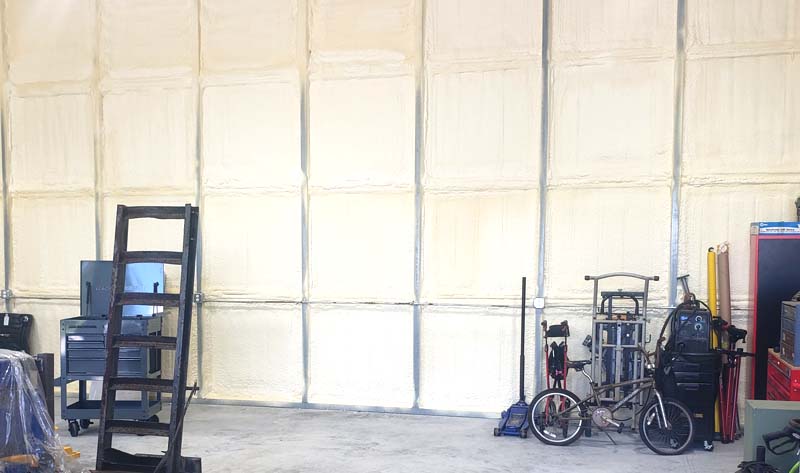
Closed-cell spray foam is applied as a liquid that expands to fill cavities and bond to surfaces. The DOE confirms that foamed-in-place insulation fills even the smallest cavities to create an effective spray foam air barrier. At approximately 1.5 inches or more, closed-cell foam qualifies as an air barrier material on its own. Since air carries more than 98% of the water vapor moving through building cavities, air sealing is a top way to control moisture.
Vapor Control and Condensation
In a cooled building, the cold surfaces are on the interior side of the envelope. Humid outside air migrates in and condenses on whatever it reaches first that’s below the dew point. That could be the insulation, the framing, or even the metal structure. Closed-cell foam is denser and far less vapor-permeable than open-cell, which makes it a reliable spray foam vapor barrier for Florida’s hot-humid climate. It bonds directly to metal surfaces, helping to eliminate the air gap where condensation would otherwise form and providing effective condensation control in metal buildings.
High R-Value Per Inch
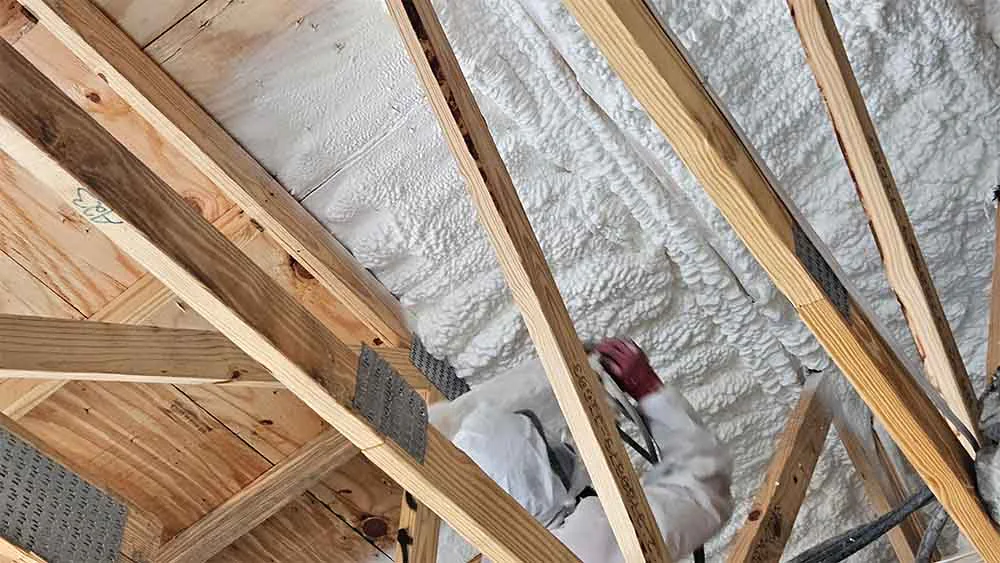
Closed-cell foam delivers a higher R-value per inch than open-cell foam or traditional batts at the same thickness. That performance advantage is often the deciding factor in retrofit work and in metal buildings where framing depth or clearance is limited. This is especially true when closed-cell spray foam’s R-value performance is needed in a confined space where more insulation simply cannot be added.
The bottom line is that the building envelope is your first line of defense for everything inside. Closed-cell spray foam metal building applications protect on three fronts in one pass: heat, air, and moisture.
Where Closed-Cell Spray Foam Fits in Florida Commercial & Industrial Buildings
For commercial spray foam insulation Florida projects, closed-cell foam is especially well suited to three building types.
Metal buildings
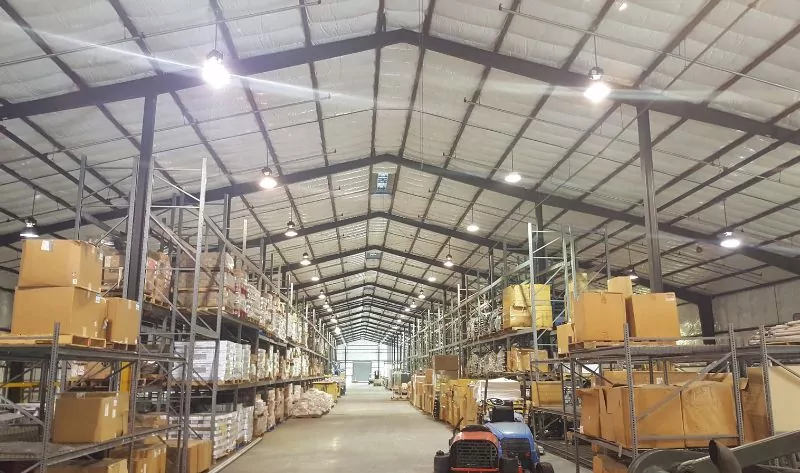
Steel heats and cools quickly, so metal panels and roof decks in metal buildings hit dew-point temperatures fast. Closed-cell foam works as a highly effective metal building insulation. When applied to the metal it forms a continuous bonded layer that controls condensation by stopping air movement.
Cold/food storage and refrigerated warehouses
For food storage facility insulation and other temperature-controlled building insulation applications, the continuous duty load and the risk to stored product make envelope control a higher priority.
Older or hard-to-condition buildings
For older structures, spray foam retrofit work with closed-cell foam is the best choice because it bonds to existing substrates and conforms to irregular structures without needing a full rebuild.
Frequently Asked Questions
For temperature-controlled, metal, and moisture-exposed buildings in Florida, closed-cell is generally the better choice. It’s denser, delivers higher R-value per inch, and is far less vapor-permeable than open-cell. Dive deeper into comparing closed-cell vs open-cell spray foam.
Yes, air sealing provides excellent condensation control in metal buildings. Applied directly to the metal, closed-cell foam forms a continuous air barrier that helps stop humid air from reaching cold metal surfaces where it would condense.
Yes. Foamed-in-place foam molds to surfaces and bonds to existing substrates, making it a practical choice for spray foam retrofit work on older or irregular structures.
Yes. Air sealing is the primary benefit for moisture control. Closed-cell foam also has low vapor permeability, making it an effective spray foam vapor barrier in Florida’s hot-humid climate.
Fiber insulation resists conductive heat transfer but does not air-seal. Closed-cell foam insulates and air-seals in one application. Since air movement is the dominant moisture pathway, that combination delivers better long-term protection for Florida’s Space/Treasure/Gold Coast commercial insulation needs.
Ready to Protect Your Building from the Inside Out?
Closed-cell spray foam insulates, air-seals, and helps control the condensation that quietly damages Florida’s commercial buildings from the inside out. That’s why it was the right solution for the aging food storage facility all those years ago, and why it continues to be the right fit for commercial and industrial buildings across the region today.
Leed Insulation and Spray Foam has been serving Florida’s east coast for over 35 years. Our team has seen firsthand what uncontrolled moisture does to commercial buildings over time. As a full-service, family-owned insulation contractor, we provide comprehensive insulation solutions and handle everything from initial evaluation to final installation across the Space Coast, Treasure Coast, and Gold Coast.
Call us today at (772) 466-0608 or request a free estimate to find out whether a closed-cell system is right for your facility.
References
Pacific Northwest National Laboratory. “Continuous Air Barrier in Exterior Walls.” Building America Solution Center, U.S. Department of Energy, basc.pnnl.gov/resource-guides/continuous-air-barrier-exterior-walls.