
If your upstairs rooms never seem to cool down and your AC feels like it runs all day, your attic may be the culprit. In Florida, attics can get brutally hot in summer, and many homes are still insulated at code minimum or below. That might satisfy inspection requirements, but it does not always deliver the comfort or efficiency homeowners expect. With attic temperatures often soaring above 130°F on peak summer days, more insulation is needed, not less.
2023 Florida Building Code insulation requirements for attics in Climate Zone 2A (the hot-humid zone that Fort Pierce and most of Florida falls into) call for a level of R-38 of insulation, while ENERGY STAR insulation recommendations for Florida point to R-49 for an uninsulated attic. Adding that roughly 29% extra insulation, especially when paired with air sealing, can make a real difference in comfort and cooling costs.
Not sure where your attic stands today? A free insulation evaluation can show where your home is losing energy and money. Keep reading for a closer look at why Florida attics get so hot, the gap between code minimums and recommendations and the insulation upgrades that deliver the biggest energy savings.
Why Your Attic Gets So Hot
The Physics of Florida Attic Heat
Here in the Sunshine State, our roofs take a beating from the sun. Dark shingles absorb a large amount of solar heat, and that heat moves into the attic through the roof deck. From there, it spreads through the attic floor via conduction through insulation and framing, radiation from hot attic surfaces to cooler attic surfaces, and convection through air leaks in the ceiling plane.
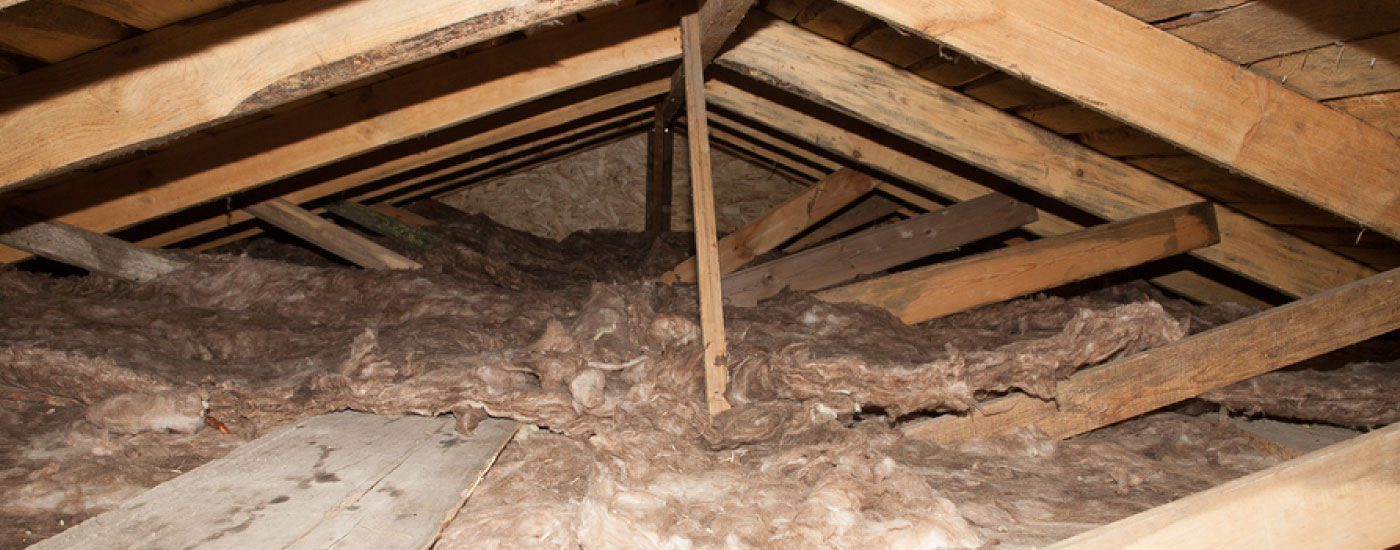
UCF’s Florida Solar Energy Center (FSEC) has documented that conventional vented attics with dark shingle roofs can reach peak air temperatures of 130°F+ at the insulation surface. This creates a temperature difference of about 55-60°F between the attic and the conditioned floor below. Yikes! This quickly leads to hot rooms, uneven cooling, and higher electric bills.
Why Code-Minimum Insulation Isn’t Enough
The IECC Climate Zone 2A insulation R-value Florida attics require (R-38) is the lowest-performing amount of insulation a builder can install and still pass inspection. That’s an important benchmark, but it’s not a promise of the best comfort or the lowest energy bills. It also doesn’t fully account for the extreme radiant heat Florida roofs experience 200+ days of the year.
Many older Florida homes still have attic insulation levels closer to R-19 or R-30, which leaves a bigger energy gap between the attic and the living space below. In our climate, where cooling is the priority for much of the year, homeowners often benefit from going beyond code because sticking with the minimum may leave savings on the table.
The R-Value Gap — Code vs. ENERGY STAR
Code Minimum vs. Recommended R-Value
for Climate Zone 2A
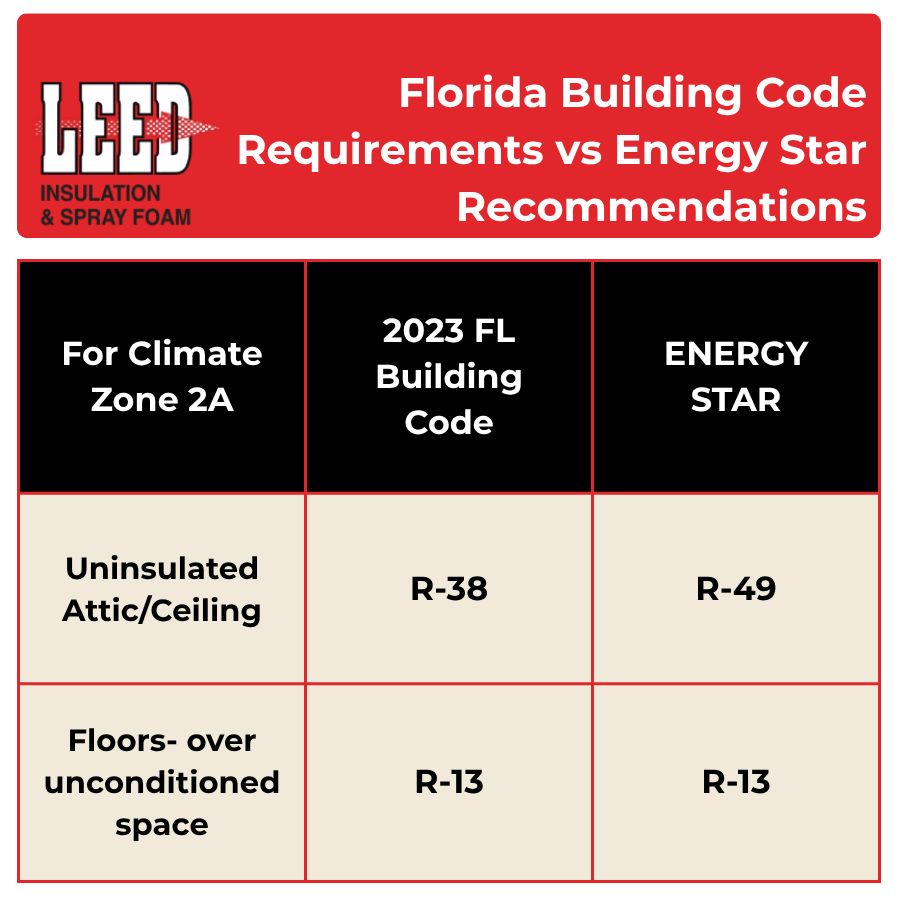
Florida’s 2023 building code and ENERGY STAR’s recommendations are both based on the 2021 IECC (International Energy Conservation Code) Standards. Florida modified their attic insulation standards from the original IECC standards document. ENERGY STAR recommends approximately 29% more insulation for Florida attics to help maximize a home’s energy efficiency.
Why the Gap Matters on Florida’s Coast
Heating and cooling use the largest share of a home’s energy, so proper insulation can lower utility costs and reduce environmental impact. ENERGY STAR estimates homeowners can save about 15% on their heating and cooling costs, or 11% on total energy costs, by air sealing and adding insulation in key areas such as attics, as well as floors over crawl spaces. An analysis of Florida homes ranks attic insulation upgrades and duct sealing among the most cost-effective improvements in our state. Since Florida homes rely on AC for more than six months each year, those savings can add up quickly over a long cooling season.
Which Upgrades Deliver the Best Return
Priority 1: Attic Insulation
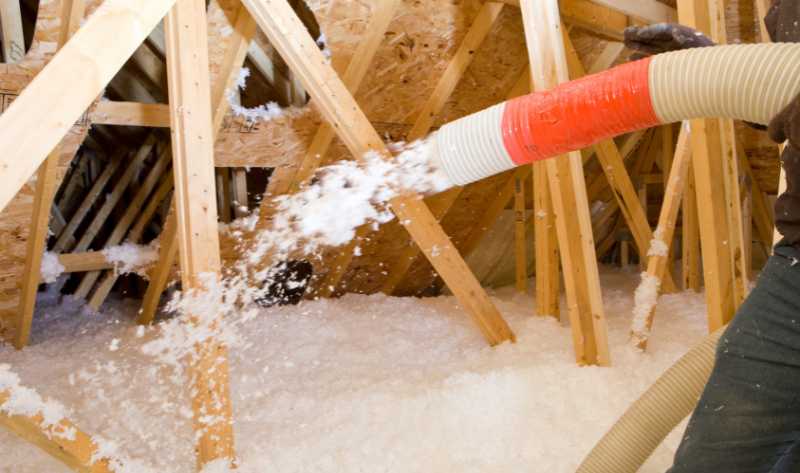
For most homes, attic insulation is the first place to start. It’s considered the most important location and the best return on investment for insulation upgrades. This is thanks to the heat radiating from your superheated roof deck throughout our long summers. If your current insulation is low, adding blown-in insulation attic material, such as cellulose or fiberglass insulation, is often the most cost-effective way to improve performance. Upgrading from R-19 or R-30 to R-49 is a practical solution for homeowners trying to improve comfort without jumping straight to a full attic redesign.
Priority 2: Air Sealing + Spray Foam
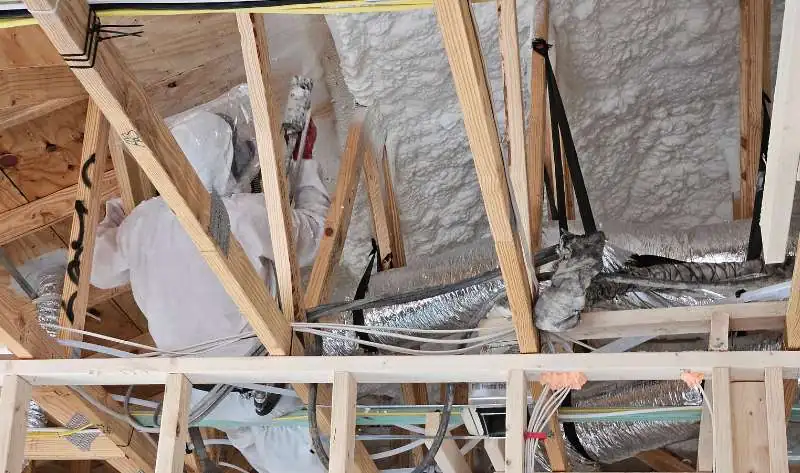
Insulation works best when air leaks are controlled. Gaps around attic hatches, recessed lights, wiring penetrations, and ductwork boots allow cooled air to escape into the attic. That’s why air sealing your Florida attic should always be part of the conversation. The U.S. Environmental Protection Agency agrees. They emphasize that air sealing should accompany insulation upgrades for the best results.
Many homeowners choose spray foam insulation for their Florida home because of its unique ability to insulate and air seal with just one application. Closed-cell spray foam is ideal for roof decks, rim joists, and hard-to-reach areas, while open-cell spray foam is an ideal option for interior wall cavities.
Priority 3: Radiant Barrier
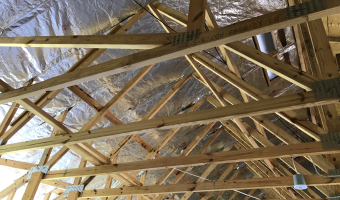
A radiant barrier for your Florida home can also help reduce heat gain from the roof. This foil barrier can block up to 95% of your roof’s radiated heat. Research by the FSEC found an average 8-degree drop in maximum daily summer attic temperature after installation, along with indoor temperatures averaging more than 2°F cooler. Combining a radiant barrier with upgraded attic insulation delivers layered protection against Florida’s extreme roof heat.
Frequently Asked Questions
UCF’s Florida Solar Energy Center has measured peak attic air temperatures above 130°F under standard dark shingle roofs in Florida homes. Roof surface temperatures can exceed 150°F+ on the hottest days. That extreme heat radiates down through the attic floor, forcing your AC to work harder.n content.
For new homes in Climate Zone 2, Florida building code insulation requirements list R-38 for ceiling/attic assemblies.
ENERGY STAR recommends R-49 for uninsulated attics in Zone 2 and R-38 for attics that already have about 3 to 4 inches of insulation.
ENERGY STAR estimates average savings of about 15% on heating and cooling costs when homeowners air seal and add insulation in key areas. In Florida, much of that benefit shows up through lower AC demand.
Blown-in fiberglass or cellulose is cost-effective for open attic floors. Spray foam (open- or closed-cell) provides insulation plus air sealing in one step, making it ideal for roof decks, rim joists, and sealed attic applications. Radiant barriers add an additional layer of protection against radiant heat.
We’re Here to Help You Keep Your Cool with an Energy-Efficient Home
Your attic is one of the biggest sources of unwanted heat gain in your home, and code-minimum insulation was never meant to be the last word on comfort. For many Florida homeowners along the Space Coast, Gold Coast, and Treasure Coast, the best next step is to improve their attic insulation from at or below code minimums to ENERGY STAR’s recommended levels. Pairing that insulation upgrade with air sealing and a radiant barrier will deliver the best combination of energy savings and indoor comfort for your Florida home.
Homeowners across the east coast of Florida count on LEED Insulation and Spray Foam for tailored insulation solutions. With more than 35 years of experience, a strong local reputation, and services that include fiberglass, spray foam, and radiant barriers, our expert team knows how to build a cooler, more efficient home for Florida’s climate. Contact us today for a free insulation evaluation for your East Coast Florida home.
References
ENERGY STAR. “Methodology for Estimated Energy Savings from Sealing and Insulating.” U.S. Environmental Protection Agency, www.energystar.gov/saveathome/seal_insulate/methodology.
ENERGY STAR. “Recommended Home Insulation R–Values.” U.S. Environmental Protection Agency, www.energystar.gov/saveathome/seal_insulate/identify-problems-you-want-fix/diy-checks-inspections/insulation-r-values.
Florida Building Commission. “FSEC Residential 2023 FBC-EC vs 2021 IECC Stringency Comparison.” Florida Building Code, www.floridabuilding.org/fbc/commission/FBC_0124/Commission/FSEC_Residential_2023_FBC-EC_vs_2021_IECC_Stringency_Comparison_Final.pdf.
Florida Department of Agriculture and Consumer Services. “Insulation.” My Florida Home Energy, www.myfloridahomeenergy.com/help/library/weatherization/insulation/.
Insulation Institute. 2023 Florida Building Code: Summary of Key Residential Energy Code Requirements.” NAIMA. https://insulationinstitute.org/wp-content/uploads/2025/05/N117-FL-Energy-Code-0425.pdf.
National Renewable Energy Laboratory. “Florida Residential Energy Efficiency Potential.” ResStock, U.S. Department of Energy, http://resstock.nrel.gov/factsheets/FL.
Parker, D.S., J.R. Sherwin, and M.T. Anello. “FPC Residential Monitoring Project: Assessment of Attic Radiant Barrier Systems.” Florida Solar Energy Center, University of Central Florida, FSEC-CR-1231-01, 2001, www.fsec.ucf.edu/en/publications/html/FSEC-CR-1231-01-es/index.htm.
University of Central Florida, Florida Solar Energy Center. “Attic Insulation and Ventilation.” FSEC Energy Research Center,http://energyresearch.ucf.edu/research/buildings-research/roof-assembly/attic-insulation-ventilation/.
University of Central Florida, Florida Solar Energy Center. “Monitored Summer Peak Attic Air Temperatures in Florida Residences.” FSEC Energy Research Center, http://www.fsec.ucf.edu/en/publications/html/fsec-pf-336-98/.
U.S. Department of Energy. “Insulation.” Energy Saver, www.energy.gov/energysaver/insulation.