
Most Florida homeowners assume attic insulation is simple. Add enough fiberglass to the attic floor, pass inspection, and you’re good.
But across Florida, including along the Space Coast, Treasure Coast, and Gold Coast, homes have HVAC equipment and ductwork sitting in a hot, vented attic. In summer, that attic can become a brutal place for the system that is supposed to cool your home.
Under the standard 2023 Florida Building Code path, many East Coast Florida homes need R-38 attic-floor insulation in Climate Zone 2, while Broward County homes in Climate Zone 1 typically use R-30 as the baseline. That can meet code, but it often leaves ducts in unconditioned attic air.
That is where Florida’s new Section 553.9065 Florida Statute (effective July 1, 2025) changes the conversation.
This latest addition to Florida’s building code creates another path to energy efficiency. An unvented attic with at least R-20 of air-impermeable spray foam insulation at the roofline can meet the 2023 Florida Building Code when four specific conditions are met, including passing a blower door test, whole-house ventilation, and keeping all HVAC equipment and ductwork inside the thermal envelope.
Not sure whether this new path fits your home or if traditional attic floor insulation makes more sense? A free estimate can help you evaluate both options for your home.
What Section 553.9065 Actually Says
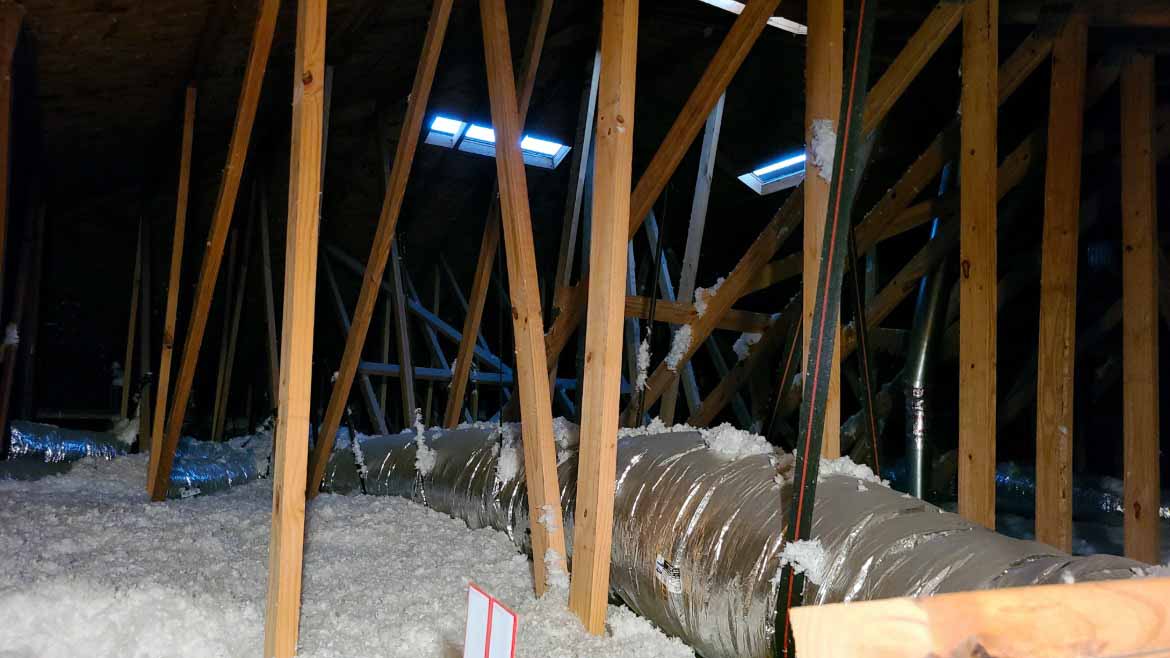
Before this statute, there was one primary prescriptive path for attic insulation: insulate the attic floor to the R-value required for your climate zone.
For much of the east coast of Florida, including Brevard, Indian River, Martin, St. Lucie, and Palm Beach counties, that meant R-38. In Broward County, it meant R-30.
The new Florida Building Code unvented attic path works differently. It says an unvented attic or enclosed rafter assembly insulated and air sealed with at least R-20 air-impermeable insulation can satisfy Section R402 of the 2023 Florida Building Code, Energy Conservation, when these four conditions are met:
- The home passes a blower door test with an ACH50 below 3.
- The home has proper whole-house mechanical ventilation.
- Exposed rafter sections not covered by the R-20 insulation are insulated to at least R-3, unless covered by a finished ceiling or continuous insulation above the roof deck.
- All indoor HVAC equipment and ductwork are inside the thermal envelope.
In plain English, being R-20 spray foam Florida code compliant by following this alternate compliance path does not mean less insulation in the same attic. It means the insulation is placed at the roofline instead of the floor, the attic becomes part of the home’s conditioned space, and the HVAC system no longer has to fight extreme attic heat. And the benefit of this high-performing insulation system with less product than they would think.
Why the Roofline Outperforms the Attic Floor in Florida
In many Florida homes along the Space, Treasure, and Gold Coasts, the HVAC air handler and ductwork are found in the attic, not in the living space. A standard vented attic can reach 150°F or more during our Florida summers, forcing equipment to run in extreme conditions.
The US Department of Energy (DOE) has documented that ducts in these conditions can increase energy use for heating and cooling by 10% through conductive heat loss and gain. The DOE says that for the best HVAC performance, ducts should be installed within a conditioned part of the home.
That is the logic behind the new R-20 prescriptive path. When you apply spray foam insulation to the underside of the roof deck, the insulation boundary moves from the attic floor to the roofline. This creates a conditioned attic Florida homeowners can use to protect ducts, air handlers, and comfort.
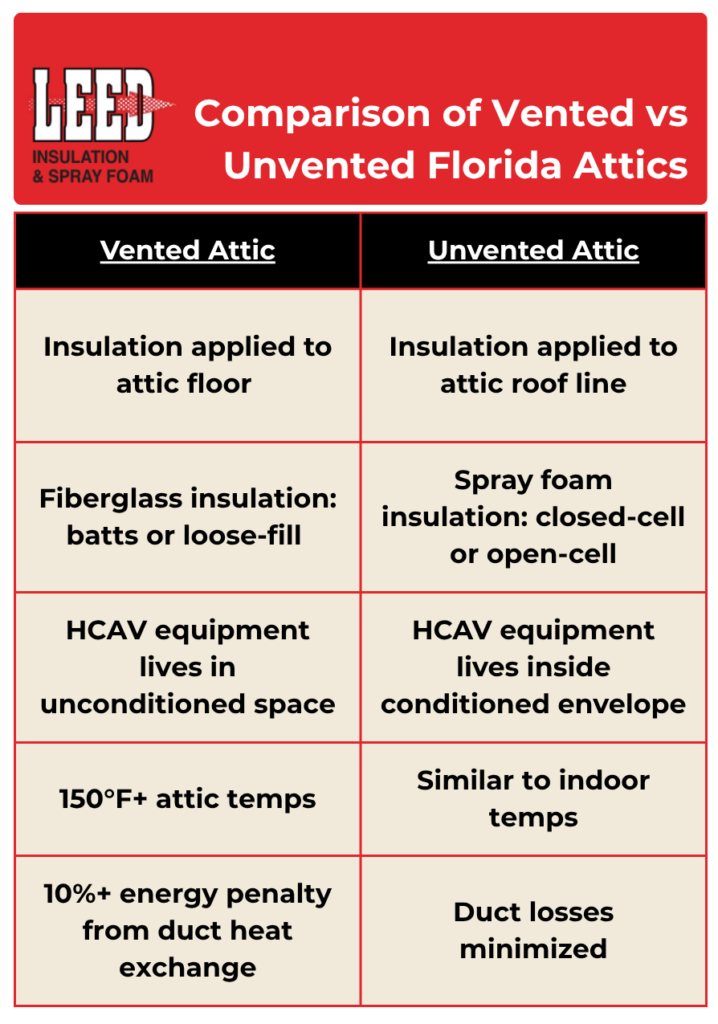
The chart compares vented and unvented attics.
The Four Conditions — Explained for Homeowners
Completing the pathway for the new Section 553.9065 Florida Statute requires more than simply adding R-20 of spray foam to the attic roofline of your Florida home. There are four specific conditions that must also be met.
Condition 1: Blower Door Test Under 3 ACH50
The blower door test attic Florida requirement checks how leaky the home is. A large fan is placed in an exterior doorway and measures air changes per hour at 50 pascals of pressure. For this code path, the result must be under 3 ACH50. That shows the home is sealed tightly enough for the unvented attic system to work as intended.
Condition 2: Whole-House Mechanical Ventilation
A tighter home needs controlled fresh air. That means a positive input ventilation system, or a balanced or hybrid whole-house mechanical ventilation system.
This matters here in Florida because humidity control is just as important as temperature control. Uncontrolled air leaks that vented attics can bring hot, damp air into the space where HVAC equipment operates. Unvented spray foam assemblies address this issue much more effectively.
Condition 3: Exposed Rafter Insulation (If Applicable)
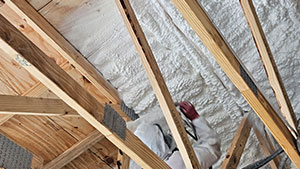
If spray foam is installed below the roof deck and parts of the rafters remain exposed (not covered by the R-20 insulation or directly covered by a finished ceiling), those areas need at least R-3 air-impermeable insulation. The statute includes one exception: rafter coverage is not required if continuous insulation is installed above the roof deck instead.
This condition helps reduce thermal bridging at the rafters. That is when heat moves through the wood framing around the insulation layer. R-3 insulation on these exposed sections prevents that shortcut around the thermal boundary.
Condition 4: HVAC Inside the Thermal Envelope
This is the heart of the new path. All indoor heating, cooling, and ventilation equipment, and all ductwork, must be within the building’s thermal envelope.
That is why this option can be especially helpful for homes with attic-mounted HVAC systems. It treats the attic as part of the system, not as an afterthought. In some homes, other hot-climate upgrades, such as a radiant barrier, may also be worth discussing.
Homeowners should also ask about open cell vs closed cell spray foam attic options. Open-cell foam usually needs more thickness to reach R-20. Closed-cell foam reaches R-20 with less thickness, but the right choice depends on the roof assembly, budget, and project goals.
Frequently Asked Questions
Yes. Section 553.9065 F.S., effective July 1, 2025, allows minimum R-20 air-impermeable insulation in an unvented attic assembly when all four required conditions are met.
It is an attic without traditional ventilation openings. The insulation moves to the roofline, usually with spray foam under the roof deck, so the attic, including HVAC equipment and ductwork, becomes part of the home’s conditioned envelope.
Not exactly. R-30 or R-38 attic-floor insulation is still a valid path. The R-20 roofline option is an alternate compliance path when the full system meets the statute.
Yes, if it meets the R-20 air-impermeable requirement. Open-cell usually needs more thickness than closed-cell foam (about 5.5 inches compared to 3-3.5 inches), so roof framing and available space matter.
It is a test that uses a calibrated fan mounted in an exterior door to pressurize the home and measure air leakage. The new unvented attic path requires less than 3 ACH50 (air changes per hour at 50 pascals) to confirm the home is tight enough for the system to perform properly.
Take the Path to an Energy-Efficient Attic & Home
Florida’s new R-20 attic rule is not just about using less insulation. It is about placing insulation where it can protect the whole home system.
For many homeowners along Florida’s East Coast, the biggest energy weakness is not the attic floor. It is the HVAC system running through a superheated attic. This new unvented attic path may be the best way to deliver better energy performance, humidity control and longer HVAC equipment life than a higher R-value on the attic floor. The key is meeting all four conditions. Once met, R-20 spray foam at the roofline is not a shortcut; it’s a legislatively recognized system approach that is specified in the Florida code.
Leed Insulation and Spray Foam can help you choose the right path, whether that is the new R-20 unvented attic option or traditional fiberglass attic insulation. Our expert team of insulation specialists serves Florida’s Space Coast, Treasure Coast, and Gold Coast with honest guidance, professional installation, and free estimates. Contact us today to get started.
References
Florida Legislature. “Chapter 553 Section 9065 — Thermal Efficiency Standards for Unvented Attic and Unvented Enclosed Rafter Assemblies.” The Florida Senate, 2025 Florida Statutes, www.flsenate.gov/Laws/Statutes/2025/553.9065. Enacted as s. 7, ch. 2024-191 (HB 267), signed May 17, 2024; effective July 1, 2025.
U.S. Department of Energy. “Unvented, Conditioned Attics — Building America Top Innovations Hall of Fame.” Office of Energy Efficiency & Renewable Energy, www.energy.gov/eere/buildings/downloads/building-america-top-innovations-hall-fame-profile-unvented-conditioned.
U.S Department of Energy. “Blower Door Tests.” Energy Saver, https://www.energy.gov/energysaver/blower-door-tests.
U.S. Department of Energy. “Minimizing Energy Losses in Ducts.” Energy Saver, www.energy.gov/energysaver/minimizing-energy-losses-ducts.
U.S. Department of Energy. “Whole-House Ventilation.” Energy Saver, https://www.energy.gov/energysaver/whole-house-ventilation.
Pacific Northwest National Laboratory. “Vented versus Unvented Attic.” Building America Solution Center, U.S. Department of Energy, https://basc.pnnl.gov/resource-guides/vented-versus-unvented-attic.