
When snowbirds return to Florida’s Treasure and Space Coasts in October, their homes might seem a bit different after being closed for months. There may be a musty smell, a damp closet, or heavier air.
Heat, humidity, and still air can impact a house left empty for months. If the thermostat is set too high or the AC runs infrequently, indoor humidity can exceed 60%, increasing the risk of mold.
Homes with proper insulation and air sealing are better at keeping humid outdoor air from getting in through gaps and leaks. That’s why snowbird home humidity in Florida is not just about the thermostat setting. It also depends on how well your house controls moisture while you’re away, and what you discover when you come home.
When returning to your Florida home after summer, take a moment. A strange smell, dampness, or changes in the attic can clue you in on what happened while the house was closed.
What Really Happens Inside a Closed-Up Florida Home All Summer
Why an empty house is not a paused house
Florida’s heat and humidity still impact your house, even when no one is there. When temperatures inside a closed house climb above 85°F, indoor relative humidity can exceed 55% to 60%.This creates conditions that support mold and bacterial growth.

Humidity damage in an empty house can start before you notice any smells, stains, or other warning signs.
The AC’s second job is moisture removal
Most people think an air conditioner just cools the house. In Florida, it also acts as the main dehumidifier, pulling moisture from the air.
As the AC runs, moisture collects on the cooling coil and drains out of the house. That helps pull humidity out of the indoor air. If the AC is off or the thermostat is set too high, it won’t run enough to remove moisture. Using the right AC settings while away in Florida keeps it running often enough to manage indoor moisture.
What the EPA says drives mold indoors
The EPA’s guidance is straightforward: control the moisture. Indoor humidity should stay below 60%, ideally between 30% and 50%, because moisture control is key to mold control.
This is especially important for mold control in Florida homes. Cleaning a visible spot might help initially, but you still need to manage the moisture causing the problem.
The Warning Signs to Check the Day You Walk Back In
A homeowner’s arrival-day walkthrough
Before you unpack, take a few minutes to walk through the house.
- Check for a musty smell around closets, cabinets, and the attic hatch.
- Look for condensation trails, soft or swollen drywall, or dark spotting along baseboards and interior corners.
- Inspect and clean the AC condensate pan and drain line to reduce mildew and mold-spore growth that can spread through the house.
- Feel wood furniture, closet contents, and accessible attic insulation for unusual dampness or tackiness.
These signs don’t necessarily mean there’s mold in a vacant Florida home, but they’re worth paying attention to. They can indicate excess moisture somewhere in the house.
When it’s more than surface mildew
A musty smell can disappear once you open the house and get the AC running. But if attic insulation has absorbed moisture or lost its shape, that’s a bigger problem. It may not manage moisture and heat transfer as well as it should.
Why Some Homes Fare Better Than Others: The Building Envelope Connection
Insulation as a moisture-control layer, not just a heat-control layer
Insulation does more than help manage heat. When paired with air sealing, it also helps block humid outdoor air from getting inside. A home with good insulation and tight sealing can keep indoor humidity more stable, even when the AC is set for vacation.
Attic conditions also make a difference. HVAC systems with equipment and ductwork in a hot, humid vented attic may have to work harder to manage moisture. Our post on Florida’s R-20 Unvented Attic Code covers that attic setup and the insulation trade-offs.
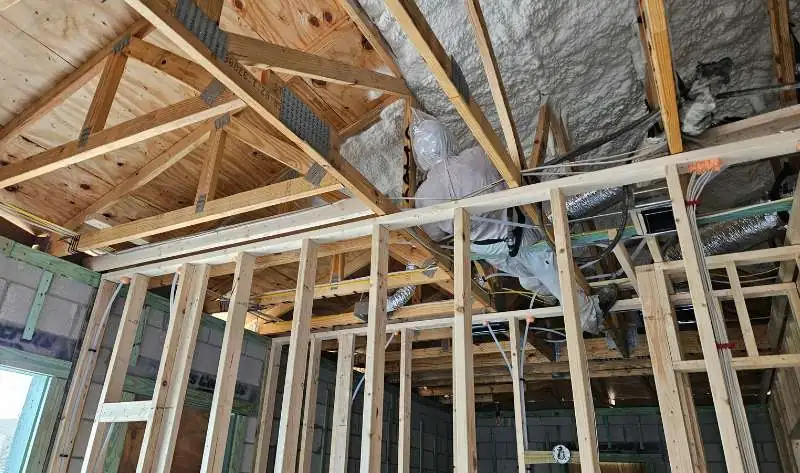
Insulation moisture control in Florida works best when insulation, air sealing, and the HVAC system all work together.
Spray foam and air sealing
Gaps and seams in your home’s structure allow humid outdoor air to get inside. Closed-cell spray foam creates an air barrier that limits unwanted air movement. Spray Foam Insulation helps reduce pathways through which humid outdoor air can get inside.
Concrete block homes and injection foam
Many homes on the Treasure Coast are built with concrete block. Without proper insulation, the wall cavities can trap moisture. You can add Injection Foam to existing block-wall cavities to improve insulation and help manage the conditions that let moisture build up.
For seasonal residents, Treasure Coast snowbird home care means watching for issues in the walls, attic, and any air leaks around the house.
Preparing Now for Next Summer’s Departure
Building a pre-departure checklist for next spring
What you find this October can help inform what you do differently when closing up your Florida home for the summer next year.
Set the air conditioner no higher than 85°F while the home is empty so it still runs often enough to remove moisture. Set it to 78°F when you’re home and 82°F when you’re away to help balance comfort, energy use, and humidity management.
About three weeks before you leave:
- Schedule an AC checkup
- Clean or replace the air filter
- Clear the condensate drain line
- Check the condensate pan
- Have the humidistat calibrated
- Make sure the AC is set to continue cycling while you are gone
These steps can make a real difference when you come back in the fall.

Where insulation fits into the plan
Setting the thermostat helps, but it won’t solve the problem if humid outdoor air keeps getting inside. Getting your insulation and air sealing checked before you leave in the spring can reveal gaps that let humid air move through your home during the summer.
A radiant barrier can help reduce attic heat gain, making it easier for your cooling system to manage humidity while the house is empty.
Frequently Asked Questions
Set the AC no higher than 85°F so it continues to cycle and remove moisture. For a typical setting while away, 82°F can balance energy use and humidity control.
Relative humidity inside a closed home can exceed 55% to 60% once indoor temperatures climb above 85°F and the AC is off or set too high.
A musty smell, dark spots on drywall or baseboards, damp closets, and softened or stained attic insulation can all point to a moisture problem. If you notice these signs when returning to your Florida home after summer, try to find the source of the moisture instead of assuming it will go away when the house cools down.
Insulation and air sealing together help limit the uncontrolled air movement that carries humid outdoor air into the home. This means your AC has less moisture to manage while it cools your home.
What should I check on my AC before leaving for the summer?
About three weeks before you leave, schedule an AC checkup, clean or replace the filter, clear the condensate line, and have the humidistat calibrated.
When you return in October, it’s a good time to see how well your house managed over the summer. If you notice damp spots, musty smells, attic moisture, or other changes, make note of them. They can help you decide what to fix before leaving again next spring.
The thermostat is important, but it doesn’t do everything. Insulation and air sealing also affect how much humid outdoor air your cooling system needs to handle.
Before the next snowbird season, Leed Insulation & Spray Foam can check your insulation and air sealing to find any areas that might need attention. Request a free estimate before you leave for the summer so you have time to make improvements before the house sits empty again.
References
United States Environmental Protection Agency. “A Brief Guide to Mold, Moisture, and Your Home.” EPA, 18 Feb. 2026, www.epa.gov/mold/brief-guide-mold-moisture-and-your-home.
United States Environmental Protection Agency. “Mold Course Chapter 2: Why and Where Mold Grows.” EPA, 1 Dec. 2025, www.epa.gov/mold/mold-course-chapter-2.
Peart, Virginia, et al. “Closing Your Seasonal Home.” EDIS, no. FCS3154/HE887, University of Florida IFAS Extension, 15 Apr. 2026, ask.ifas.ufl.edu/publication/HE887.
Zhuang, Yilin. “Water Wednesday Recap: Understanding Florida Homes.” UF/IFAS Mid-Florida Research and Education Center Blog, University of Florida, 31 July 2026, blogs.ifas.ufl.edu/mrec/2026/07/31/water-wednesday-recap-understanding-florida-homes/.